
[ad_1]
On Wednesday, at an office in the Manipur chief minister’s secretariat, a group of 12 top officials from different government agencies, who are working to restore normalcy in the state, met to review and formulate their strategy to counter-insurgency operations, maintain law and order, and ensure the safety of the communities in the state. October 3 marked five months since the ethnic clashes between Kuki and Meitei groups first began.
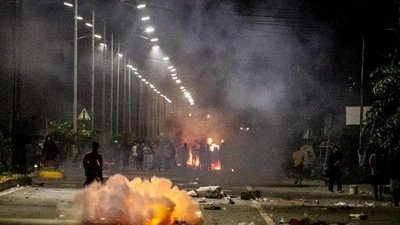
In Manipur, where 178 people have already died, 50,000 rendered homeless and boundaries have been redrawn along ethnic lines, the 12 officials comprising the Unified Command structure meet on the first Wednesday of every month — a routine they have followed when the Governor Anusuiya Uikey ordered its formation after Union home minister Amit Shah visited the state on May 29.
Retired IPS officer Kuldiep Singh, who is the former chief of the National Investigative Agency and has also commanded the Central Reserve Police Force, is the chairperson of the command. In fact, on May 4, a day after the clashes started, Singh, already retired, was flown into Manipur on a special flight. He was appointed as the security advisor to the state government and the state police was asked to report to Singh.
How does the unified command work? Who are its members? How does a unified command help in war/violence-torn places? HT spoke to different security forces on the ground and experts for the answers.
Composition
An order from the Manipur commissioner (home) dated May 31 detailed who the 12 members of the command would be: The state chief secretary, III Corps Commander (a three-star general), the director general of police (Manipur), administrative secretary (Home), additional director general of police, General Officer Commanding, 57 Mountain Division, the inspector general of police (Intelligence), as well as senior-most representatives of Assam Rifles, CRPF, BSF, IB. In short, all major army, police and intelligence units operating in the state are working together in this command.
Though Manipur chief minister Biren Singh is not a member, he may call a meeting when required and head it, the order read.
“Unlike cities or other places in India, the northeast is a different place when it comes to security. Some columns of Assam Rifles or Army are always posted in Manipur. The state shares its border with Myanmar and there is free movement of people from both sides at the international border up to 16 km. Army and Assam Rifles have their own sources there. It is not like they were suddenly parachuted after the violence. So multiple agencies mean multiple inputs, which need to be developed and worked on. We cannot duplicate work or compromise on intelligence networks because of a lack of cooperation. This is when a unified command helps. It is at these meetings that intelligence and the goals are discussed so that all agencies are working on the same tangent,” said a security force officer posted on the ground.
This is not the first time that such a unified command system has been set up. A similar mechanism was in place in Assam, Punjab and Jammu and Kashmir to tackle insurgency.
Retired IPS officer, Shesh Paul Vaid, former director general of the J&K police, said the unified command mechanism was a success in Jammu and Kashmir (J&K). “The unified command there had senior officers from police, army, paramilitary forces, IB and RAW. It is the most essential structure when there are multiple agencies on the ground. In J&K, the enemy was different. We had foreign elements and a proxy war launched by the enemy from outside. The situation in Manipur is different. But because of the multiple agencies there, a unified command comes in handy. The intelligence sharing between agencies in a war-like zone is the biggest advantage that such a multi-agency command brings to the table. Plans are made to execute the actionable intelligence. The best teams work on gathering intelligence. When all agencies come together under one umbrella with the same goal in sight, the results will be excellent,” he said.
During his time as the police chief and in his earlier stints in the J&K police, the chairperson of the unified command there was the chief minister. At present, it is co-chaired by the director general of J&K police and the commander (three-star general) of the Chinar Corps.
Its significance in Manipur lies in the fact that multiple agencies were brought together within a short span of time and asked to restore normalcy in a tinder-box situation.
Coordination
The Manipur police have a strength of less than 40,000. With the state police short of numbers in dealing with the incidents of violence that were reported from across the state, all the country’s paramilitary forces – CRPF, BSF, SSB, ITBP, and CISF have been airlifted to Manipur. They work in conjunction with the Indian Army and Assam Rifles. There are around 200 companies (around 100 in one company) of paramilitary forces and 160 columns (around 118 in one column) of Indian Army and Assam Rifles. Together there are nearly 40,000 more personnel from the Army and paramilitary forces.
The officer quoted above said that the command helped resolve issues that cropped up when different forces were caught in a turf war. In at least two reported cases over the last five months, Manipur police and Assam Rifles personnel were caught in a confrontation on the ground. Manipur police reports to the state government, while the Assam Rifles is the Centre’s force.
“This issue was taken up during one such meeting of the unified command in August and resolved among the top officials. Such controversies happen when multiple forces are on the ground. But to minimise it, there is an overarching body in the form of the unified command,” the official added.
Groups within the command
The unified command also has smaller groups that meet regularly. One of them is the strategic and operations group (SOG). The SOG is a team of 13 officers headed by Singh, the government’s security advisor, top police officers, brigadier rank officer of the Army, IG of CRPF, DIG rank officers of Assam Rifles and BSF, chief secretary and state intelligence bureau head.
While handling counter-insurgency is a top priority for the SOG, the group has been specifically tasked to devise and implement effective measures for checking extortion, ensuring the security of VIPs, vital installations, National Highways and crisis management. The SOG meets twice every fortnight.
And then there is a third group too: the Operational Intelligence Group (OIG), which has just 8 members. Headed by the Manipur police chief, one IG rank police officer, and the deputy director of IB, the other members are intelligence representatives from the Army, Assam Rifles, BSF and CRPF. The OIG meets every Friday for analysis and coordination of inputs with a special focus on the activities of various insurgent groups. The OIG also ensures timely sharing of actionable intelligence with field operational units of the police, Assam Rifles, Army and paramilitary forces.
“An officer has been designated by all forces as nodal officers. The officer’s job is to ensure that every piece of intelligence is followed and designated to the correct agency. In intelligence gathering when too many agencies work on the same lead, the information is compromised. The unified command in case of major intelligence tip-offs and the OIG in the case of daily inputs ensure this does not happen,” the officer quoted above added.
Officials aware of the meetings of the unified command said that every major counter-insurgency or law and order arrangement work is discussed in the meeting. “Be it suspension of the internet or launching an operation, every important operation is discussed in the meeting. Each agency is given a specific task. For example, security forces have recovered around 40 arms and around 100 pieces of ammunition in different operations in the last one month. Such operations in remote jungle areas only happen because of inter-agency coordination. Almost every major operation is discussed by the top officials,” the official said.
How efficient is this unified command in a situation of ethnic violence?
Retired IPS officer Prakash Singh who was police chief in Assam and headed the BSF in Punjab where a similar unified combined headquarters was in place during the insurgency problem in the 1980s and ’90s, said, “A unified command can be effective as the political wing wants it to be. Unified command in Punjab during the mid-80s was successful because the then governor Sidhartha Shankar Ray was a bold man. He had dealt with the Naxals in Bengal and never shied away from taking bold decisions. .”
Singh said that a similar structure was there in place in Assam during the Assam Separatist Movement launched by the United Liberation Front of Asom (ULFA). “My belief is that the head should always be someone in uniform or a person who has dealt with insurgents or militants on the field. In Assam, the chief of the unified headquarters was the chief secretary. He was an honest man but could not make bold decisions. Despite different agencies under him, the unified headquarters was ineffective. I remember him telling me about a kidnapping by the ULFA. The chief secretary said we had lost the battle. I had to tell him that the battle had just begun. There is no dearth of good officers. You just find a man who can get the job done and make him the head of the command.”
[ad_2]
Source link